Showing posts with label health. Show all posts

Monday, April 27, 2009

The Sweet Wars

It's amazing how much science and marketing energy goes into creating a substance that tastes like sugar with no calories. The Showdown at the Coffee Shop is now a Sergio Leone-quality stare down.

Stevia has long been popular as a sweetener in Japan and other countries, but for years the United States Food and Drug Administration has blocked it. In 1995, after pressure from the American Herbal Products Association, a trade group, the government allowed its sale as a dietary supplement, not something that could be used as an ingredient in food. But some large food and drink manufacturers, sensing an eager audience for a sugar substitute perceived as healthier than the rest, began investing in research and lobbying the government.
Never forget what is driving the American food industry. It's not health and it's not safety. They have little interest in long-term studies of how something like Splenda or stevia might impact health over the course of many years. No, it's more about customer loyalty to pink, blue, yellow, or now green packets (brilliant!) of formulated pseudo-sugar.

Because, really, simply eating less sugar is apparently not an option! When has the food industry or government encouraged you to eat LESS of anything? That's a preposterous notion! No, eat MORE fiber. MORE fruits and vegetables. Even "eat less red meat" gets translated into "choose meats low in saturated fats." Never will the industry or government suggest that we eat LESS. Again, because HEALTH is not the driver of these decisions...the bottom line is. Eating less would hurt the bottom line even if it might help our collective waistlines.

Tuesday, April 21, 2009

How Much Would Legalizing Pot Help Economy?

Not much. So says Harvard economist Jeffrey Miron in this NPR article.

Jeffrey Miron, a Harvard economist who has modeled and written on the economics of the marijuana market, figures state and federal taxes on cannabis sales add up to $6.7 billion annually.

And he calculates the savings from not having to enforce state and federal marijuana laws — in arrests, prosecution and incarceration — at $12.9 billion a year. Excluding additional expenses, such as the public health cost of marijuana, or the cost of administering the new law, Miron figures that legal pot creates almost a $20 billion bonus. Miron adds, however, that the people who thought the taxation of marijuana would create a windfall for government coffers will be disappointed.

"Compared to the size of most federal government agencies, compared to the tax revenue from things like alcohol and tobacco, and certainly compared to the size of deficits that we have, this is just not a major issue, it is not a panacea, it is not curing any of our significant ills," he says. "There may be good reasons to do it, but the budgetary part is not a crucial reason to do it."


NPR has been all over the marijuana question lately with commentators of all stripes as the "legalize it" crowd has gotten louder during the economic downturn. But, the argument for MJ as an economic panacea is not convincing.

Tuesday, February 3, 2009

A Bessie By Any Other Name

The BBC reports that dairy cows with names produce more milk than unnamed cows. They also have less cortisol (a stress hormone) in their system.

BBC Video Story (<2 min long)

Is it the act of naming the cows, or is the name an indicator of farmers who care about their animals and treat them better than mass dairy farms? My Freakonomic sensors say it's the latter.

Tuesday, January 27, 2009

Blog Resurrection and Fries

OK, I've taken long hiatuses (hiati?) before and came back. It's been awhile. I will try to be more frequent here during the semester.

I shared this video with my students on the first day of class today. It was a jaw-dropper. Most of them were stunned. I realize that this may not be an experiment conducted in a lab with perfect controls, but I think the general purpose is served.

Food breaks down by natural processes. Outside the body, it molds and decomposes over time. Well, most food does. This 5-minute video pretty much explains why I don't eat at McDonald's.

McDonald's Fries Defy Nature

Sure, our stomachs have strong acids that can break down most anything. That's not the point. The point is: why don't these fries decompose on their own by natural processes outside the body?

Don't mess with nature and creation. It usually has dire consequences.

Wednesday, July 2, 2008

11 Best Foods You Are Not Eating

And, in some cases, they are relatively inexpensive foods, too. From the NY Times wellness section:

Eat These Eleven

To be honest, I don't eat beets. But, I'm willing to shred them and try them as a salad base. I'll let you know how that goes.

Thursday, June 5, 2008

Genetic Limits of Obesity

The latest reports suggest that childhood obesity is leveling off. Whatever the reason, that's good news. Hopefully, it will start to decline.

But, some experts suggest that we've merely saturated the field of those predisposed to become obese at a young age. Here is a snippet, but you can read the whole piece here.

If, at 17 percent, we've hit the "saturation" point for child obesity, we're extremely lucky. There's no historical basis for knowing where the saturation point is, since our species has never before lived in an environment so full of ease and abundance. The far more dangerous possibility is that the saturation point is higher. In fact, given that we evolved in conditions of scarcity, it's logical to suspect that the tendency to seek and store fat is nearly universal. As the Los Angeles Times observes, "the idea that childhood weights have simply topped out doesn't quite square ... [One expert] said the fact that 60% of U.S. adults were either overweight or obese suggested that children had plenty of room to grow."

Monday, February 18, 2008

Largest Beef Recall in U.S. History

First, the good news: experts suggest that the chances of a major health crisis caused by this meat is "remote."

Now, the bad news:

The Humane Society of the United States showed videotapes on January 30 showing workers at the plant using several abusive techniques to make animals stand up and pass a pre-slaughter inspection. These included ramming cattle with forklift blades and using a hose to simulate the feeling of drowning.
These animals COULD NOT STAND on their own. It's illegal to slaughter an animal in this condition because IT IS SICK and should not be consumed. This was discovered because of some undercover video work at Westland and Hallmark Meat Co. How often is this happening when there are no cameras around?

This is the largest beef recall in U.S. history: 143 million pounds of it. And where do you think much of this meat was destined? Why, the Federal School Lunch Program and fast food chains, of course!!! In other words, kids--mostly.

I'm not a (mostly) vegetarian because of any moral issues with killing animals for food. I am a (mostly) vegetarian because of the meat industry. I am also not an evangelistic (mostly) vegetarian. But, if I don't catch it or kill it myself out of the wild, or if I cannot purchase free range or wild meats, I simply do not eat it if at all possible.

And, this situation is a big reason why.

Tuesday, February 12, 2008

Fattening of America

The Freakonomics blog addresses an issue near and dear to me. I've been teaching this in my classes for years. I find some of the conclusions and rationale suspect, but here's an excerpt from an interesting interview with health economist Eric Finkelstein that talks about his (and co-author Laurie Zuckerman's) new book The Fattening of America :

In sharp contrast, children are unable to make rational choices, unlike Uncle Al. I think that the government (and parents) have a critical role to minimize the possibility of children growing up to regret the diet and exercise choices they may have made as uninformed youths. Most government interventions are focused on schools, which makes sense given that the food the lunch ladies serve up is too often not that different from the birthday fare my son receives at Chuck E. Cheese. And then, of course, there’s the school vending machines. In my book, we discuss what’s happening in America’s school cafeterias, gymnasiums, and classrooms, and what can be done to help tomorrow’s adults make informed diet and exercise choices.
If we TRULY want a healthier America, we might have to take our legislative medicine when it comes to protecting kids.

Wednesday, October 10, 2007

Poopeating Grin

A call to ingest more fecal matter from Slate.com.
Our food is hosed and boiled and rinsed and detoxified and frozen and salted and preserved. Recently, we have begun to irradiate it, too—just in case. As a result, when our bodies encounter the occasional inevitable bug, they're unhappy. Our centuries-long program of winnowing out all the muck has turned us into sissies and withered the substantial part of the immune system mediated by our intestinal tract.
This is why I do not feel so badly about letting my nine-month-old lick floors and chew on our 100-year-old traveling wardrobe which serves as our coffee table.

I think I'll ask for a side of axle grease and a splash of poo with my oatmeal at Teresa's on Friday.

Tuesday, September 11, 2007

Kids and High Blood Pressure

Expect more and more news like this if we do not turn around the obesity trend in our nation's children.

The prevalence of HBP (High Blood Pressure) and pre-HBP in children and adolescents showed a downward trend between 1963 and the 1988-1994 survey. But the trend began to reverse through 2002. For example, the prevalence of high blood pressure in all children and adolescents decreased from 11.1 percent in the 1976-1980 (Black and white) and 4.7 percent in 1982-1984 survey (first national survey for Mexican-American youth) to 2.7 percent in the 1988-1994 survey (all children), but rose to 3.7 percent in the 1999-2002 survey (all children).
Pre-HBP is a reliable predictor of early organ damage, thickening of the heart walls, and lesions in the aorta.

Just another reminder than the health care solution is in our pantries, cafeterias, and lunch boxes, not in political solutions to treat a nation that lives a lifestyle prone to sickness. We cannot simply treat the symptoms; we must treat the illnesses of apathy and convenience on the front end. Namely, how we eat, sleep, and exercise.

Tuesday, July 24, 2007

Sugarcoating It


Joel Stein of the LA Times has written a wonderfully funny piece on kiddie cereals.

"While I appreciated the honesty of Sugar Pops (bran, wheat, rice, corn -- who cares? It's got sugar in the name!), it seemed too desperate and bland. The Froot Loops mascot baffles me to this day. It seems like an ad campaign created by a wine snob: '"You see, guys, this toucan with an enormous nose, kind of a supertaster bird, is going to fly around pointing out notes of strawberry, lemon and dark cherries in the cereal. Kids will love it!"'

"Seeing Past the Sugarcoating"

Thursday, July 19, 2007

Obesity: A Visual

Check out the growth of obesity epidemic in visual format. It's a map of the U.S. and a year-by-year update starting in 1985. It is pretty startling. It was not that long ago that no state had an obesity rate higher than 14% (1985). Now, practically every state is at 20% or higher and a full third of states are 25% or more. Mississippi, Louisiana, and West Virginia are over 30%!

Fast food and snack food companies say that people have to take "personal responsibility" for their choices. That may be true, but this kind of shift does not occur without some SERIOUS help from marketing and a titanic shift in cultural values and behavior.

Notice that Kentucky and several other southern states are always among the most obese states.

TURN THE TIDE. Personal choice, legislation, whatever...I do not care. Just do your best to find an effective way to change this. It is hurting our bodies, our minds, our lifespan, and our quality of life. We do not have to be ultra-thin, world-class athletes, beautiful, or have ripped abs. We can be a lot fitter and allow our bodies an easier way do their job by streamlining a bit.

Tuesday, July 3, 2007

Indulge

I feel like I've been something of a huge killjoy regarding food on here lately, so here's some tasty news.

1. Dark chocolate is good for you in small amounts. It not only has high antioxidant levels, but it now has a clinical study that shows it reduces blood pressure. Granted, the allowance is small, but a little chunk of dark chocolate goes a long way.

Try this. Cook up a cup of plain, whole oats (not pre-sweetened, packaged outs). Toss in 1 tbsp of peanut butter and one tbsp (NOT heaping) of chocolate chips. Add just a little brown sugar. Stir it up, and enjoy a breakfast that tastes like an oatmeal cookie. It's best with a tall glass of cold milk, of course.

2. You don't have to go all-organic. It's simply not worth it in some cases. One reason organic fruits and veggies are so expensive is that they are shipped from across the globe. By the time it gets to rural Kentucky, it's old and has lost a lot of nutrients. Buy from your local farmer's market. The nutrients and money saved likely outweighs the pesticide levels that we worry about.

Besides, many thick-skinned fruits and vegetables absorb very little pesticide (bananas, for example). More porous foods like strawberries or thin-skinned foods like grapes may be worth their organic price, but local and non-organic food is often more nutritious than store-bought organic.

For pregnant women and small children, low pesticide levels are important, simply because the body weight of a fetus or an small child is proportionally much lower than adults. Therefore, ingesting pesticides has a greater impact. Therefore, with small kids and expectant moms, organic is probably best if you can swing it.

I am a big organic food supporter, but having an "organic" sticker does not automatically make it a better choice every time for everyone.

3. Almonds lower LDL ("bad") cholesterol. Buy some raw almonds and place them on a baking sheet in a single layer. Preheat your oven to 400 degrees, and toast the nuts for 6-7 mins. Take them out and let them cool. They will be super-crunchy and flavorful. Replace a couple hundred calories of your daily intake with a good handful of almonds (about 16 individual nuts), and enjoy the taste and the health benefits.

4. Use spicy food to reduce inflammation. If you suffer from sore muscles, tendons, or arthritis, partake of some hot salsa or other food of your choice. Cayenne, chili peppers, or crushed red pepper are commonly used in many Mexican and Tex-Mex dishes.

There are lots of others I can put on here. But, I mainly wanted to say that eating well does not mean that we have to eat blandly or have our food become boring.

Enjoy the holiday tomorrow.

Thursday, June 28, 2007

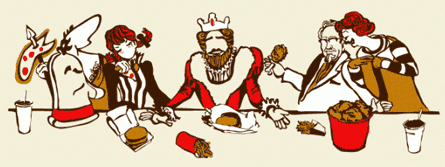
The Fast Supper

Da Vinci's The Last Supper


And, the Fast Supper


I love how they put the feminine character to the right of "The King" creating Dan Brown's "chalice" image from The Da Vinci Code. Clever.

They make T-shirts, if anyone has an itch to buy me something.

Tuesday, June 26, 2007

Shaq Attack on Fat

Behold! An NBA superstar does something to be admired: he is attempting to change the lives of several kids who have been diagnosed as "morbidly obese" and at severe risk for health problems. In the previews for Shaq's Big Challenge on ABC's Good Morning America today, it appears that much of the problem lies with parents who are unable to say "no" to their kids requests for food.

Shaq is doing his part to turn around some disturbing trends in American health.

1. According to the U.S. Surgeon General, American children born in 2007 may have a shorter life expectancy than their parents. This is attributed mainly to lack of exercise, poor dietary habits, and subsequent complications from this lifestyle including obesity, diabetes, heart disease, and many other other ailments.

2. Americans are shorter in stature than their their European counterparts. This was not always the case. Economist Paul Krugman writes,


There is normally a strong association between per capita income and ...
average height. By that standard, Americans should be taller than Europeans:...
But ... something has caused Americans to grow richer without growing
significantly taller.


Why is this so? The changing ethnic mix you say? Nope, says Krugman.

It’s not the population’s changing ethnic mix...: the stagnation ... is clear even ...[for] native-born whites.


Americans are a wealthy lot compared to just about any country, but many other countries are growing taller than we are.

3. The U.S., with our immense wealth, top-notch medical facilities, access to education, and being the world's superpower, should have the highest life expectancy of any country, right? Well, that's asking a lot. But, top 10 for sure...right? No. Top 20? Top 30? Top 40? No, no, and no. We checked in at #45 according to the 2007 World Fact Book, behind nearly every country that most folks consider "highly developed." Japan, Switzerland, Australia, France, Iceland, Canada, Italy, Spain, Norway, Israel, Greece, Austria, Netherlands, New Zealand, Germany, Belgium, Finland, Jordan, Puerto Rico, and Bosnia and Herzegovenia all rank ahead of the U.S. among many other smaller countries. Why?

As an aside, most of these countries have a lower infant mortality rate, too. Again, I ask, why?

Do these countries have better health care? Better access to it? Better genetics? I doubt that any of those are true. I would hypothesize that they have healthier lifestyles. When visiting Spain a couple of years ago, an older Spanish lady told me that the secrets to their long lives and healthy bodies were "olive oil and lots of walking."

So, I will tune in at 8 pm central to see Shaq's "tough love" approach with these kids. I generally hate reality TV and since Lost is in reruns, there is not a single TV show that I watch on a weekly basis. I will watch tonight mostly out of sheer curiosity.

It is significant that a person weighing 335 pounds is doing this. He has just 14% body fat, which is in the low-normal range for a man. It would not be nearly as effective if some 150-lb fitness trainer was doing this show. Shaq is literally and figuratively larger than life for these kids. For all of my blogging against our weight trends in the U.S., a healthy body has little to do with how thin a person appears. There are plenty of healthy people who are viewed as "bigger" or "heavy."

God gave us all a body. Some of us are better designed for marathoning. Others are better suited for basketball. Still others have the build for swimming, power-lifting, football, or some other activity. An individual's ideal body is not found on the Gap Iconostasis, or on the pages of fashion magazines. Shaq's ideal body weight is 335, give or take. Serena Williams will never be small, but she is quite fit and an amazing athlete. Charles Barkley, while a bit pudgy these days, was known as the "Round Mound of Rebound" in his playing days, but he was a brick house. He was just wide. The U.S. Women's soccer team has done wonders for projecting an image of healthy bodies over just thin ones. (A longer "body image" post will have to wait until another day.)

We all will not and should not look the same, but we can all strive for health whether our ideal weight is 120, 150, 200, or 335. Hopefully, Shaq can help turn the tide for kids in this country.
He has been a collegiate All-American, an MVP, an NBA Finals Champ, a clothing/shoe mogul, a rapper, and an actor. This health thing should be a piece of cake...rice cake, that is.

Thursday, June 21, 2007

Dream Away

As Americans battle their bulging waistlines with pills, Ab Lounges, crash diets, hours in the gym, Joggin' in a Jug, or some other program or drug (or even surgery), they may be ignoring a simple but effective ally in maintaining their health: sleep. Research on how sleep affects weight and general health is still in its infancy, but there are already important academic studies that link sleep to obesity and decreased life expectancy among many other health problems (increased stress, digestive disorders, high blood pressure, increased risk of stroke/heart attack, it's a long list).

How much sleep is enough? Well, everyone is different, but it seems the greatest health risks occur primarily among those who sleep less than seven hours per night, those who have frequently interrupted sleep, and those with sleep disorders. Most people have an "ideal" sleep time of 7-9 hours of quality, uninterrupted sleep.

Many Americans seem to take pride in "getting by" on less sleep, linking their lack of rest with good work ethic and a willingness to do whatever it takes to achieve their goals. That simply feeds the "faster" culture that has been discussed here before. Like poor dietary habits, the cumulative effects will not be felt for years or maybe decades, so the current consequences of just "feeling bad" or tired are tolerated. Sleep is sometimes viewed as "wasted" time, and people even go as far as to avoid it or fight it off by staying up too late, then relying on caffeine to jump start them in the morning and keep them awake in the afternoons and evenings. We have more important things to do than, say, give our body its biologically required time to rest, heal, and keep us healthy.

Our body regulates certain bodily functions while we sleep. In regards to weight control, two very important hormones are regulated primarily during sleep. Leptin and ghrelin may sound like Tolkien characters, but in actuality they are hormones that regulate our appetite and our "full" mechanism.

One hormone, ghrelin, which triggers appetite in humans, was found at higher
levels in people who regularly underslept. Another hormone, leptin, which lets
the body know when it is full and should stop eating, was found at much lower
levels in people who did not get enough sleep.(1)

Depriving our bodies of sleep disrupts our ability to identify real hunger or when we feel full. Obviously, this contributes to overreating and late-night snacking which leads to excess caloric intake.

Apart from weight gain, our bodies do important repair work while we rest. When engaging in physical training, increased strength, endurance, and speed all come from a simple formula: stress+recovery. Too many rely on a stress+stress pattern. When a goal is achieved, they immediately push to the next goal. In my training, I do no more than 3-4 "hard" runs per week. The other days are strictly easy, pleasurable runs or off days. Doing 6-7 hard workouts per week does not make me faster (trust me, I've tried this). It wears me down and sets me up for injury and burnout. I think the formula for daily life is similar: work hard, play hard, rest hard...well, that does not quite work, but you get the idea.

If you are a Navy Seal, maybe you have to condition yourself to survive on four hours of sleep per week during Hell Week (first week of training). But, for those of us living our daily lives without the immediate threat of extreme sleep deprivation or "sleep torture," we should make sure that we are getting adequate shut-eye. It helps us recover, repair tissue, "reset" our brains, control our appetites and hunger mechanisms, maintain a healthy body weight, and lowers our risk for myriad health problems.

There is an old saying that the sleep-deprived often trumpet in their defense: "I'll sleep when I'm dead." C'est vrai, but perhaps we can prolong the coming of the Big Sleep by taking getting (roughly) eight hours nightly in the present time. Adequate sleep can improve one's quality of life simply by giving a biological need it's proper place in our list of priorities.

CEREAL UPDATE
I knew that there had to be a reason I had missed out on the Kroger 100% Natural love fest. When I picked up a box in the store this week, I remembered why: 2 g of Trans Fat per serving. I calmly put it back on the shelf. This "100% Natural" is a farce.

"Kroger, the nation's biggest food retailer after Wal-Mart, sells a store-brand
granola, '100% Natural Cereal,' that contains partially hydrogenated cottonseed and soybean oil. But none of its natural-category products include high-fructose corn syrup, Kroger spokesman Gary Huddleston says."(2)
Shame on you, Kroger. The "100% Natural" title is incredibly misleading. It's like "All Natural" 7UP. It still has high fructose corn syrup. I'll stick with Kashi.

(1) http://news.nationalgeographic.com/news/2005/02/0224_050224_sleep_2.html
(2) http://www.organicconsumers.org/articles/article_1039.cfm

Thursday, June 14, 2007

Tony the Tiger Slims Down

On the heels of yesterday's post, Kellogg's announced today that they are setting a new standard of responsibility in my beloved cereal aisle. The commitment is two-pronged: 1) more careful in the way that they market to children, and 2) front-of-the-box nutritional information.

Never underestimate the power of litigation. Some will argue that parents' suing McDonald's or Kellogg's for a child's obesity is ridiculous. Maybe. But, a little fear of the law and some good muckraking journalism can go a long way. Look at the changes McDonald's and Wendy's have made since the book Fast Food Nation (2002) and the documentary Supersize Me (2004) hit the scene. Those events coupled with a few attempts to sue McDonald's for contributing to obesity and subsequent health problems have created at least a gentle wind of change (cue The Scorpions).

The U.S. House of Representatives passed the Personal Responsibility in Food Consumption Act in 2004 (also known as the "Cheeseburger Bill"), but it did not receive a Senate vote. Most of these lawsuits against McDonald's and other fast food corporations have been turned down by the courts. But, the bad press and attention have shed light on a lot of the evils and poor nutrition of fast food, and that has prompted at least a minor shift in marketing and food options.

Tuesday, May 29, 2007

Not Lovin' It

Anyone who knows me well has to be utterly shocked that I have waited this long to post about fast food. With the other blogs that I read are currently filled with heavy (and quality) discussions on church and faith, I figure it might be a good time for me to indulge in one of my far-too-frequent tirades against those who would control our taste buds, wallets, wastelines, and children if at all possible.

What triggered this was an event in my office yesterday. I dropped by to do a little work with my 5-month-old son in tow. I happened to mention that we were going to a birthday party tonight for a little friend who is turning one year old. The first question from our departmental office associate: "Are you going to McDonald's?" This is not solely about how bad the food is for us. It touches many parts of our lives and serves as an indicator of larger cultural trends.

The long arm of fast food extends FAR past the drive-thru window. Unlike other aspects of popular culture like music, fashion, film, or sports, food culture becomes a part of us physically. We ingest it and it goes into our bloodstream and organs. Listening to Flock of Seagulls in the 1980s may have prompted you to get a weird hair cut and now serve as the butt of jokes at current family reunions or when old pictures are reviewed, but it did not affect your cholesterol, clog your arteries, or make you obese. Overindulgence in fast food culture may have done (and may do) just that.

So, here are some reasons to limit your trips to the drive-thru.

1. It's bad for you. Have you ever cooked a hamburger at home on a grill? Does it look, taste, or feel like a McDonald's hamburger? How does Mickey D's get their burgers to taste the same in Miami, Florida, as in Seattle, Washington? How come they do not shrink when cooked? It is mainly because what you are tasting is not a hamburger at all. What you are tasting are chemicals. Leftover meatish parts from hundreds of slaughtered cattle thrown into a hopper, ground up, and fashioned into a uniform, bun-sized patty. The flavor largely comes from IFF (International Flavors and Fragrances). Eric Schlosser has this to say in his 2002 book Fast Food Nation:


In addition to being the world's largest flavor company, IFF manufactures
the smells of six of the ten best-selling fine perfumes in the United States,
including Estée Lauder's Beautiful, Clinique's Happy, Lancôme's Trésor, and
Calvin Klein's Eternity. It also makes the smells of household products such as
deodorant, dishwashing detergent, bath soap, shampoo, furniture polish, and
floor wax. All these aromas are made through essentially the same process: the
manipulation of volatile chemicals. The basic science behind the scent of your shaving cream is the same as that governing the flavor of your TV dinner.

The taste does not come from just the food. So, not only is it high in calories, fat, trans fat (in some cases), salt, and mostly devoid of nutrition, but the taste comes from the same folks who give Pert Plus it's smell.

2. It hurts local businesses. It's tough enough for small sandwich and coffee shop owners to make it. It's nigh impossible when a fast food restaurant sets up shop across the street or next door. Is Subway cheaper than Bread and Bagels (a local sandwich shop in Bowling Green, KY)? Yes, it is. Which one has higher quality food with better ingredients, an infinitely better atmosphere, works with local farmers, and has a vested interest in Bowling Green? B&B. All that for a dollar more at lunch time! What a bargain!

Do you enjoy drinking coffee and seeing bands at Spencer's? Do you like the excellent sandwiches at B&B? Support them.

Some argue that dollar menus appeal to those with little money. I would argue that they should not be eating at a restaurant at all, and even if they do...

3. It is expensive. One of the greatest tricks of the fast food industry is proclaiming it's economic value, especially through "value menus" or "dollar menus." A sandwich, fries and a drink from the dollar menu will still cost you $3.15 in Kentucky. That works out to a cost of $9.45 per day or roughly $70 per week. I can buy high-quality, organic food for two people with $70 per week. Further, a pound of turkey ($5), 1/2 pound of cheese ($2.50), a loaf of bread ($2), six or seven bananas ($2) and drinking water costs about $11.50--and I'm talking about the good stuff here. One could make at least six meals from these groceries. That's less than $2 per meal.

Fast food is not cheap. I understand that some folks in dire financial straits without a stove at home can enjoy a hot meal at a fast food restaurant for $3-4, and that is understandable. But, if you are reading this blog, this probably does not apply to you.

4. It is not faster. Time yourself. Make a sandwich at home and eat it. Then, one day, drive to a fast food restaurant at lunch time, order, get the food, and eat it. I'll go 10-1 that the homemade lunch is faster. If you have leftovers from dinner the night before, that's even better!
5. It is aimed at kids. "Brand imprinting for later actuation in life." That is what McDonald's brass calls it according to Morgan Spurlock's documentary, Supersize Me. In other words, a seven-year-old has more lifelong buying power than a 70-year-old. So, it's clowns, playgrounds, birthday parties, coloring and legos. It's happy meals gift-wrapped in colorful boxes and pseudo-hamburgers wrapped in fun paper, and it all comes with the latest California Raisin figurine (1980s), beanie baby (1990s), Incredibles (2000s), or (insert new Disney movie here) toy. The nation decried Joe Camel and had him axed, yet Ronald McDonald is something of a hero and more first-graders can correctly identify Ronald than they can common portrayals of Jesus in a picture lineup. To me, Joe Camel and Ronald are two sides of the same coin; they get the hooks of addiction in into kids at an early age. That may sound strong, but no six-year-old brain is a match for the salty, cheesy, sugary, caffeine-laced concoction of the standard McDonald's meal. Heck, it hooks adults fairly easily. Couple that with the toys, parties, playgrounds, and general good-feelings, and the psychological impact is massive.

6. It reduces small-town character. Most people probably care less about this than I do, but it pains me to drive through the South and see that the interstate exits at all of the small towns look the same: Cracker Barrel, McDonald's, Wendy's, Burger King, Subway. Lather, rinse, repeat. I enjoy an occasional blueberry pancake overload at Cracker Barrel as much as the next guy, but basically what CB has done is taken the idea of the hometown country store/restaurant and replicated it on a massive scale. The irony would be funny if not so sad. It is an imitation of the real thing (like say, Teresa's or Judy's Castle or Murray's...).

And that is ultimately the crux of the matter. The continuing explosion of fast food serves as an indicator of a larger trend. It's megachurch for our diets. It's Duke and North Carolina on ESPN, replacing attendance at a local, real, live college basketball game with a slick, marketed product of hype. It's Wal-Mart for our restaurants, enormous and replicating at an alarming rate...actually McDonald's IS inside many Wal-Marts. It's "convenient" and "time-saving" so that we can get on to more important things like hurrying home to watch hours of television so that they can market more fast food to us during the commercial breaks. Eating meals is what sustains our physical body. I think that is pretty important stuff.

The worst of it is that we say that we value education in this country, but the food that is available in schools is some of the worst out there. We spend resources on education and preach the value of it to kids while sending them to a lunchroom filled with low-grade food. Many college campuses' food courts are dominated by fast-food chains. Why are we not educating students on the value of taking care of their bodies? Our intellectual capacity and knowledge suffer if the body that houses them is compromised.

We often cannot see the cumulative effects of what we do to our bodies during our youth until a little later in life. Before we get older or get sick, our time, convenience, and tastes drive our actions. Eventually, when we get sick or break down, THEN we make changes to control our cholesterol, blood pressure, diabetes, weight, etc. How about a little preventative maintenance? Do we want to reform health care in this country? Start at the front end and taking care of ourselves by eating well and exercising. Of course, all of us are going to break down and need medicine at some point and some of us are predisposed to certain ailments, but Americans as a whole can certainly do more on the front end.

We marvel at the soul and human mind that God created in His image. What about the human body that is also made in his image? Why do our bodies look the way that they do? We hear lots about being good stewards with what we are given. Does this not apply to our physical body as well? Or maybe it's more what kinds of abuses we will tolerate. For many Christians, drinking alcohol, even an amount that might be physically beneficial, is frowned upon, but gorging on fried foods, ice cream, or pies on a regular basis is perfectly acceptable. Why?

I am not advocating a workout regimen in order to be a "better Christian." But, maybe we should examine the motivations and reasons for the status of our health both individually and collectively in this country.

I am also not trying to suck the fun out of eating. But, do we think of food as fuel or as fun? Hopefully, it can be a bit of both, but when food becomes a hobby it also becomes a danger.

Friday, April 6, 2007

Why Run? Part II

"I always loved running ... It was always something you could do by yourself and under your own power. You could go in any direction, fast or slow as you wanted, fighting the wind if you felt like it, seeking out new sites just on the strength of your feet and the courage of your lungs!"
~Jesse Owens

Not only that, Jesse, but it is good for your lungs as well. Some poo-poo running as "hard on the knees" or "damaging to joints" and there is some truth to that over the long haul. But, we are all destined to deteriorate at some point. Joints, bones, arteries, organs, skin, hair--these things will let us down eventually. We are all human and will break down over time. Using computers strains our eyes, hands, wrists, and back. It happens. Smart running that includes moderation, stretching, and ample recovery, hydration, and rest will help reduce some of the risks and keep us physically active for a long while.

In general, running does more good than harm for most people.

--One burns about 100 calories per mile, regardless of how fast one runs. Heavier folks burn more than lighter folks, but most of us burn about 100 cals/mile. Therefore, it works as a great weight-control activity.
--We are not mechanical, we are biomechanical. So, unlike a piston or an axle in a car, repeated use does not automatically lead to excessive wear. Gradual training of the body makes it stronger, not weaker (in general). Lifting weights does tear down muscles--hence, the soreness. But when they heal, a person can lift even more than before. The same rule applies with running. Of course, anyone can overdo it, so runners should start small and build up.
--Running leads to an increase in the production of endorphins which are nature's little fatigue and depression fighters. These little critters are neurotransmitters with pain-relieving properties. They get credit for supplying that "runners high."
--Running is a weight-bearing activity which strengthens bones.
--Running has been shown to increase blood vessel elasticity, raise HDL ("good cholesterol"), lower blood pressure, and relieve stress among many other health benefits. In fact, the farther and more intense the running, the greater the increase in HDL levels.

Get the kiddos out running, too. For the first time in American history, they may have a shorter life expectancy than we do. That is largely due to lack of physical activity and poor dietary habits. If you have a Run for Good program in your town, take advantage of it.

*Information for this piece was taken from Vanderbilt University's Health Psychology home page. For more on how running impacts HDL levels, see Paul T. Williams, "High-density lipoprotein cholesterol and other risk factors...", New England Journal of Medicine, 16 May 1996, Vol. 334 Issue 20, 1298-1303.